Five Tapes, First Reader Poll (of many)
Read the backstory on each tape below, then vote for whichever one you want to hear next so we can get to the top twenty percent much quicker, together!

Five Tapes, First Reader Poll (of many)
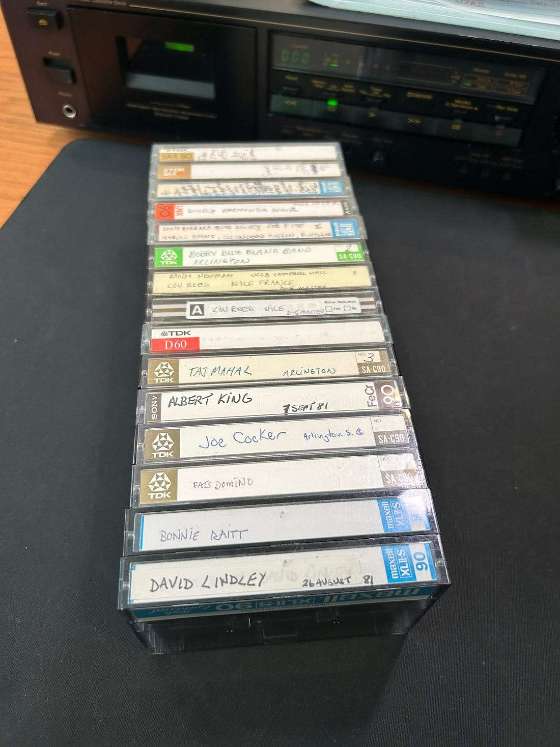
I’m looking at two large boxes of tapes tucked under my desk. I can kick them if I stretch my legs and they are never far from perception during my workday.
Roughly two hundred tapes (180? I really haven’t counted) in the two boxes total. Six months into digitizing I’m on a pace of about a dozen per year. I hope I get faster (and readers hope I get better, no doubt) at this project. But at this rate I’ll be at this for the better part of two decades, so I thought I should ask Aggrovox readers to prioritize which tapes to digitize next.
Below are five candidates — along with descriptions compiled from AI research (Claude, with a little help from Gemini). The poll is self-serving, I admit. My goal on Substack is for as many people as possible to hear these ‘miracle’ performances. If I digitize the most popular concerts first, that should lead to more readers and more exposure for the lesser known artists/performances.
The tapes in this poll were completely randomly picked off the top of call it ‘box one.’ Some famous names, and one mystery show with no date. I’ll post additional ‘5-choice’ polls in the coming days. Help me out - let’s get to the most popular 20% from the jump here!
Bobby “Blue” Bland — Arlington Theater
Possibly a second, separate Bobby “Blue” Bland tape from the handwritten note on the Taj Mahal tape.
I searched Bland’s known tour history, every concert database and setlist archive I could reach, and Santa Barbara-specific concert history for the Arlington. Nothing turned up an independently dated Bland show at the Arlington beyond the Jan. 31, 1980 quadruple bill below — which means either this is a genuinely undocumented date (very possible; Santa Barbara’s own 1980s concert history is thinly digitized, as I found repeatedly researching this list), or there’s a detail on the tape or case itself that could narrow it down. Bland toured constantly through this whole era as a chitlin’-circuit headliner, so there’s no shortage of years it could be — complicating finding a definitive date.
The Arlington Triple Bill — Taj Mahal, Hugh Mundell, Richie Cole & Alto Madness — Jan. 31, 1980
Roots-blues eclecticism, a 17-year-old reggae prodigy from Kingston, chitlin’-circuit soul, and bebop-revival alto sax — four acts, one stage, one of the stranger bills you’ll find at any American theater in January 1980.
By this point, Taj Mahal was well past his early acoustic-blues phase and deep into the Caribbean- and Africa-inflected roots music that would define the back half of his career. Bobby “Blue” Bland, the Memphis soul-blues singer behind “Turn On Your Love Light” and “Farther Up the Road,” was a chitlin’-circuit veteran by 1980, not an up-and-comer. Richie Cole, a Phil Woods protégé, toured behind his own working band, literally named Alto Madness after his breakout album — bebop, unapologetically, dropped into the middle of a blues bill.
Hugh Mundell is the real find here. He was a Jamaican roots-reggae singer discovered by producer Augustus Pablo, whose 1978 debut album *Africa Must Be Free by 1983* drew a five-star Rolling Stone review — extraordinary for a teenager (he was born in 1962, making him 17 in January 1980). His documented US touring, as far as I can find, doesn’t pick up until October 1981 (a Reggae Sunblast Festival in Berkeley) and runs through 1982 in the Bay Area. That makes this Arlington date, if it holds up, nearly two years earlier than any other US Hugh Mundell appearance I could independently document — possibly one of his first, or his first, American shows. He was shot and killed in Kingston in October 1983, at 21. If the tape has him on it, that’s a genuinely rare historical record.
The tape has a handwritten “Bobby Blue Bland” note, which may make it the home of some of the Arlington show he played. To be determined (and yes, I know I did a terrible job of labeling and indexing these tapes).
Albert King (board tape) — Sept. 7, 1981, Casa de la Raza
A board tape, not an audience recording — hopefully a cleaner sound, closer to the mic source than audience tapes on this list.
Albert King doesn’t need much introduction: a Mississippi-born, left-handed guitarist who played a right-handed Flying V flipped upside-down, and whose bent, aggressive style directly shaped Stevie Ray Vaughan and — by Eric Clapton’s own account — helped shape “Layla.” By 1981 he was a genuine elder statesman of the blues, still touring hard on the strength of his Stax-era catalog. I couldn’t find outside confirmation of this specific date — no tour itinerary or press clipping turned up — but that’s consistent with how thinly documented Santa Barbara’s small-venue shows are from this era.
Fats Domino (board tape) — July 20, 1980, Nice Jazz Festival
Fifteen songs recorded off the board at a jazz festival in the south of France, on a European tour where Domino was clearly playing the same set every night — except for the two moments where he wasn’t.
La Grande Parade du Jazz in Nice was co-run by Newport Jazz Festival founder George Wein. My tape index - made with almost half the tapes *before I figured out that they were fragile and the machines to play them effectively were also fragile - shows Fats playing the festival twice that July — once on the 17th, once on the 20th (this tape). Lining the 20th’s fifteen-song set up against two other dated, setlist-documented shows from the same European run — North Sea Jazz on July 11, Pistoia Blues on July 15 — makes clear he was running essentially the same show every night that summer: I’m Walkin’ to open, the same mid-set run through Jambalaya and Blueberry Hill and Shake, Rattle and Roll, the same closing stretch.
The audience-requested “Please Don’t Leave Me” doesn’t show up on either of the other dated sets, and the “Stagger Lee” closer is also unique. Interesting deviations, on a tour that otherwise ran like clockwork.
David Lindley & El Rayo-X — Aug. 26, 1981, Lobero Theatre
A decade of session and touring work behind Jackson Browne, then, in 1981, finally out front with his own band and his own name on the marquee.
Before El Rayo-X, David Lindley was best known as the multi-instrumentalist (fiddle, lap steel, oud, bouzouki — whatever the song needed) behind Jackson Browne’s records and tours through the ‘70s. El Rayo-X’s self-titled 1981 debut was his first real step out as a bandleader, which makes this an early snapshot of a musician reinventing his own role — the singer/frontman version of David Lindley the crowd hadn’t had much chance to see yet.
I’m certain that other artist appeared on the bill that night, but my research doesn’t offer any names and my labeling is, as usual, terrible. It occurs to me that this endeavor is often more music archaeology than archiving.
It would mean the world if you would hit the subscribe button! It’s 100% free! And, please share the Aggrovox posts with streaming audio to your friends here on Aggrovos. Having people hear these recordings, and the wonderful artists is the inspiration behind this stack. Thanks!
Get Aggrovox by email
Live tapes, unreleased concerts and the stories behind them. Free, in your inbox.
Free on Substack · Aggrovox