Press Play Before Reading - No Nukes Stop Diablo Canyon Benefit Concert Live Recording
Bonnie Raitt, Jackson Browne, Graham Nash, and Jesse Colin Young lead the U.S. “No Nukes” movement at the Diablo Canyon Nuclear power plant

Press Play Before Reading - No Nukes Stop Diablo Canyon Benefit Concert Live Recording · Aggrovox
Press play on AggrovoxThe original post on Substack, with the full audio playerAugust 6, 1978, on the beach in Avila this morning it’s foggy and cold, and the brisk onshore breeze makes it feel more like December than August. A few thousand protestors are assembling on the beach. Some stand around on the sand, and some mill around between the sand and the road in small groups of four or five people. Watching from the beach I assume that they are waiting to be picked up to carpool to the front lines.
The main gate of Diablo Canyon Nuclear Power Plant is at least a seven-mile march north along the beach from Avila. It’s a scrambling hike over rocks and low cliffs where the tide erases the sand. Some hardy souls in the crowd set their course and resolutely begin walking. The beach approach parallels PG&E property making exposure to discovery much more likely, increasing the risk of arrest before even reaching the plant. Diablo Canyon Road is an easily defended two-lane asphalt road leading to the gate - it’s the only way in or out of the plant.
A small temporary stage and speakers are set up on the beach facing south with the oil pier looming in the background. From a few hundred yards away through the moving fog the outline of the two structures look like a ghost ship stranded on the beach. Rumors of special musical guests ripple through the crowd. General announcements about timing, getting to the main gate, and more pedestrian worries like bathroom facilities drift over the sand. The speeches are coming next.
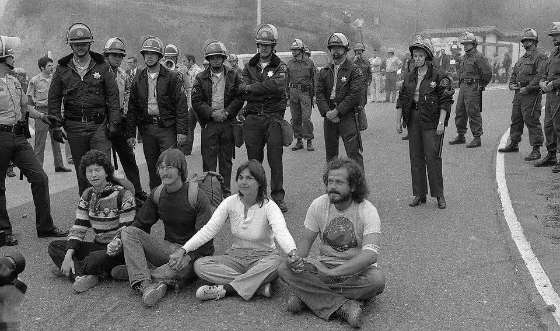
Everything about the day suggests that in a few hours the hundreds of protestors converging on the road leading to the gate and along the perimeter fence by the beach will confront the sizeable police presence marshalled at both locations.
Dozens of protestors are immediately arrested after using ladders to scale plant fencing along the beach. After several days of sustained protest, police arrest nearly 500.
Diablo Canyon is a massive construction site in the summer of ‘78, and it won’t send a single kilowatt to the grid for nearly a decade. This remote section of the coast has a beauty that rivals Big Sur, but the scar left behind by the plant will last at least a century.
Looking back the irony of protesting an energy producer in Avila, a town literally built around oil extraction is profound. In the early 90’s the entire city is nearly wiped off the map when soil tests reveal storage tanks above the town have been leaking a toxic brew into the groundwater for decades. Entire blocks of the beachfront are torn out, and the soil removed twenty or thirty feet deep and hauled away in thousands of dump truck loads. Seven miles up the coast today the same fate awaits the hundreds of acres siting Diablo Canyon.
The No Nukes Movement
The No Nukes movement owes more than a passing nod to Tom Campbell (1939 – 2024). The Pacific Alliance, and Campbell’s Avocado Productions and Guacamole Fund produced nearly all of the benefit concerts that Nash, Raitt, Browne and others played. Upon Campbell’s 2024 death, Pollstar magazine calls Campbell the “Grandfather of the Benefit Concert” in their obituary.
In the 1960’s Campbell is an aspiring musician when he writes the song “Darcy Farrow” with his partner Steve Gillette. The composition is eventually recorded by Linda Ronstadt, John Denver, and Nanci Griffith among others, and becomes a folk-circuit standard.
In 1974 Campbell produces his first benefit concert - an event Pollstar describes as an effort “to protect New Mexico wilderness areas.” It’s one of a series of shows for the same cause he produces in subsequent years featuring Ronstadt, Pete Seeger, The Nitty Gritty Dirt Band, Steve Martin, John Denver, Jerry Jeff Walker, Taj Mahal, and many others.
If the ‘celebrity benefit concert’ idea begins with George Harrison and Ravi Shankar and their “Concert for Bangladesh,” at Madison Square Garden on August 1, 1971, it’s Campbell who institutionalizes the concept. Over 50 years he produces 1,200 “cultural, education, environment, and service events.”
Campbell follows the concerts in Santa Fe with a series of shows in Oregon and California featuring Jackson Browne, Jesse Colin Young, Maria Muldaur, Bonnie Raitt, Linda Ronstadt and others. At one show benefitting forest protection many of the performers including Raitt, Browne, and poet John Trudell are chased out of town by loggers in pickup trucks revving chainsaws.
youtube.com/shorts/pLlRMmSrG4E?si=Yt34194J7E6pXZYK
Period footage, possibly from the Abalone Alliance
In 1976 Campbell joins the Pacific Alliance, sponsor of the 1981 “Stop Diablo Canyon” benefit concert streaming in the article. In 1978 Pacific Alliance is heavily involved along with the Abalone Alliance in organizing the Stop Diablo Canyon benefit, and both groups are working on a much larger No Nukes event planned for a year later at Camp San Luis Airfield. 30,000 show up to the airfield for the ‘79 event to hear Bonnie Raitt, Jackson Browne, Peter, Paul and Mary, David Lindley, and Jesse Colin Young. Notably, event organizers extract from Governor Jerry Brown a promise to oppose the Diablo plant before they grant him a speaking slot on the airfield stage.
No records found memorialize the musical performances of the foggy day on Avila beach. Raitt plays an acoustic set, and standing just in front of the stage I notice that she’s freezing on this cold day that never warms up. I offer an extra sweater I retrieve from my car - a slightly ratty oversize Mexican cable knit cardigan - but she thanks me and soldiers on. Another solo acoustic performance by Jackson Browne concludes the musical portion of event.
For more than three days protestors keep up a steady pace of attempting to breach the plant’s perimeter over the fencing and razor wire. Blockades of Diablo Canyon Rd. see empty school buses rolling toward the main gate to haul away the arrested protestors. In the months that follow most are fined $400 for trespassing.
Members of of the Abalone Alliance and other affiliated groups offer inspirational speeches throughout the protest, including one from Raye Fleming, a foundational organizer with San Luis Obispo Makers for Peace. Other speakers include David Hartsough, a prominent staff organizer for the American Friends Service Committee who schools protestors on nonviolent tactics; Dick Blankenburg, a local newspaper publisher and vocal anti-nuclear advocate; and Chumash Tribal Elders who speak to the crowd early in the day and offer an invocation of sorts for those assembled.
Pacific Alliance co-produces the MUSE (Musicians United for Safe Energy) “No Nukes” concert in 1979. The ground breaking event over five nights of music at Madison Square Garden in NYC, spawns a the three-album set (see appendix below), and a feature length documentary that chronicles the highlights from the five nights.
The shows raises over a million dollars in inflation adjusted dollars - distributed to ten prominent anti-nuke non-profit organizations.
The 1979 No Nukes film, unavailable commercially - the dramatic trailer is on IMDB: https://www.imdb.com/title/tt0081242/
The Arlington Theater Stop Diablo Canyon Concert
In Santa Barbara on April 23, 1981, it’s overcast and a dense, low coastal fog is parked over downtown. It’s still unseasonably cool from a cold late season nor ’wester storm that drops more than an inch of rain a few days before the show.
Santa Barbara claims Raitt and Jackson Browne as a native son and daughter, and between the two of them they play countless benefit concerts in Santa Barbara over more than 30 years.
In 1981 Raitt and Browne are among the most prominent voices of No Nukes and the wider environmental movement - which is literally born on a Santa Barbara beach in 1969 less than two miles from the Arlington theater. The ‘69 Santa Barbara Oil Spill (no fancy moniker, just the facts) fouled beaches for miles up and down the coast and the destruction lingered for years as a reminder to residents of the cost of uncontrolled oil extraction. The community quickly realizes that the extractors leave town with the profits the minute the oil is pumped from the ground.
Jesse Colin Young
Young begins the show, and his first song is the George Harrison composition, “While My Guitar Gently Weeps.” Unfortunately, the start of the tape is damaged before it can be ‘transplanted’ to a new housing and much of the song is irretrievable. Young then covers Jimi Hendrix’s, “Up from the Skies.” Unlike Hendrix’s original psychedelic blues vamp, Young gives the song a breezy, jazz interpretation at breakneck speed. (I’m tempted to do a ‘voice isolation’ noise gate on the recording to figure out what the young women nearby are talking about – through the whole show!).
Graham Nash
Nash begins with “Just a Song” which has a decidedly commercial, not sentimental origin story. And yet somehow here reality doesn’t fight the legend, nor detract from the fact that the song is Crosby, Stills, and Nash’s highest charting single in the band’s illustrious career. Released on June 17, ’77, with “Dark Star” on the B-side, “Just a Song” hits #7 on the Billboard Hot 100.
Graham Nash (and Leah Kunkle) circa 1981 – photo credit Acroterion, Wikimedia Commons
The song’s origin story is legendary. While staying at a low-level drug dealer’s house in Hawaii, Nash recounts that the dealer, “bet me $500 I couldn’t write a hit song before I left.” Nash says he wrote the song “in a few minutes” and that he still has the $500.
Listen closely during the second bridge as the young woman next to the mic says: “That’s so sad…” Well, yes and no.
Nash’s “Song for Susan” on the tape is possibly a more interesting story. The namesake in the song is accepted as Susan Sennett, Nash’s actress wife. The song was released on the CSN album, “Daylight Again,” June 21, 1982. Extensive research fails to discover an earlier live recording of the song than this performance a year before the album’s release. If anyone has a link to a live version of the song (at all), that would be interesting.
Jackson Browne
Browne appears to have played only one tune that night, “The Crow on the Cradle.” Originally written by Oxford-educated folk artist and poet, Sydney Carter. The song’s deep spiritual themes make it a famous anti-war protest song. Browne performs it live at the MUSE concert in Sept. ’79, and it’s in the 1980 No Nukes concert film. Elsewhere the song appears in the feature documentary film “In the King of Prussia” about the “Plowshares Eight,” the protestors who broke into the General Electric nuclear munitions plant in King of Prussia, Pennsylvania in an act against nuclear arms proliferation.
Browne is considered by most in Santa Barbara as a local. He has a ranch at the hallowed surf spot, Hollister Ranch, and plays every benefit show in town anyone can remember. He is also a regular at the Sunburst Farms diner just outside the gates of HR at the curve on Hwy 101 going north where the freeway turns inland and traverses the Gaviota tunnel (the one made famous in the film, “The Graduate”).
In October ’79 Browne plays a show at the Arlington benefitting the Point Conception Indian Center – part of the determined environmental resistance to a gigantic liquid natural gas terminal developers hope to site directly on the thousands-of-years-old “Western Gate” that features prominently in the Chumash tribal religious tradition.
The LNG terminal is defeated, thanks in no small part to the tribe which claims the land’s sacred significance to their history. Today the thousands of acres is part of a vast conservation refuge, The Jack and Laura Dangermond Preserve. The couple donated $165 million to the Nature Conservancy to purchase the former Bixby Ranch to create the current ecological preserve and working ranch in perpetuity.
Diablo Canyon is originally scheduled to begin decommissioning operations in 2025, but it continues to operate today under a ten-year extension granted by the State of California. The plant’s decommissioning is now scheduled to begin in 2030, however PG&E has applied for a full 20-year license that if granted would see it continue operations until 2045.
Epilogue
This concert tape has been fighting me for nearly two months. I try everything to make it play smoothly and after dreading what needs to be done, and after putting it off for far too long I finally transfer the tape to a brand-new donor cassette shell. Worked an absolute treat the first time!
Get Aggrovox by email
Live tapes, unreleased concerts and the stories behind them. Free, in your inbox.
Free on Substack · Aggrovox