Santana Live & Unreleased: Woodstock in Santa Barbara – Press Play Before Reading
Half of Santana’s Woodstock set turns up again at the SB County Bowl in 1980

Santana Live & Unreleased: Woodstock in Santa Barbara – Press Play Before Reading · Aggrovox
Press play on AggrovoxThe original post on Substack, with the full audio playerPress Play Before Reading
Friday Night
It’s unlikely anyone at the County Bowl on Friday night is thinking about Santana’s launch from anonymity onto the world stage at Woodstock. It’s a clear beach day and a cool, dry evening in Santa Barbara. The smell of suntan lotion and beer mixes with pot smoke as dusk envelopes the venue and the twinkling lights of Jim Morrison’s “crystal ships” emerge (oil rigs) behind the stage in the Santa Barbara Channel waters.
Woodstock defined youth, music, and politics eleven years earlier, but the sold-out crowd of over 4600 at the Bowl tonight is another generation, some perhaps living with regret at not having been there when it all started. The pot smoke wafting through the crowd is mostly the same across the decade, but even that’s profoundly different now. Instead of cheap seeds and stems from Mexico tonight’s crowd is blowing clouds of newly discovered skunk weed towards the stage.
Woodstock
Santana takes the Woodstock stage around 2 p.m. on Saturday, August 16, the second day of the festival – not a prime spot. The band is all but unknown outside of San Francisco – they haven’t released an album yet. Steadily gaining popularity with local Bay Area audiences, according to the Bethel Woods museum Santana plays Woodstock as part of a Bill Graham package deal: if the festival wants Jefferson Airplane and the Grateful Dead, it has to book Santana too. Santana pockets $750, and the Dead get $2500. Jimi Hendrix - a Woodstock headliner - nets a cool $18k!
In their 45-minute Woodstock set the band rips through eight songs. On the County Bowl recording a single song, the “Soul Sacrifice” suite is nineteen minutes long! The suite features passages from “Concierto de Aranjuez,” and an amazing Carlos solo where he plays with his guitar’s sustain like a cat with mouse.
22-year-old Carlos Santana plays a nearly 12-minute “Soul Sacrifice” at Woodstock with a shredding four-minute Michael Shrieve drum solo included. The cameras also capture “Evil Ways,” which isn’t in the original 1970 film release. It stays in the can until the 2009 bonus material comes out. Eddie Kramer, the engineer who recorded Woodstock, says Carlos was badly out of tune for the first half of the song, and that Carlos re-recorded his guitar for that half before the 2009 release; the second half is the original performance. *
Trajectory
Contemporary critics aren’t especially kind in their reviews of Santana’s self-titled first album that comes out two weeks after Woodstock. Robert Christgau, in The Village Voice gives it a C−. Langdon Winner of Rolling Stone says it’s, “a speed freak’s delight.” The band fares a little better when the film comes out in 1970, with Roger Ebert noting the triple-screen framing of the drummer and percussionists during “Soul Sacrifice,” and an editing rhythm that follows “the tense, driving Santana lead.”
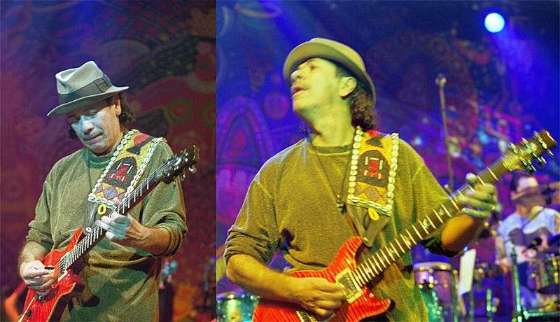
At the Bowl tonight, Carlos is the only man standing from the Woodstock stage. Michael Shrieve’s drumming is replaced by British born drummer Graham Lear. The percussion section adds a third player tonight besides Lear. The line up: Raul Rekow, congas, 26, in Carabello’s seat. Orestes Vilató, timbales, 36 in Areas’s original seat, it’s Vilato’s first year with the band, and Armando Peraza, congas and bongos, about 56, an ‘add’ beyond the Woodstock three-man percussion lineup.
The Suite
Santana performs four of the eight Woodstock songs on the tape. Listening to 33-year-old Carlos on the Bowl stage reveals a matured instrumental mastery and his deeper exploration of the original material. There’s never a hint of a sour note, even his feedback is in perfect tune.
Ninety-seconds into the Soul Sacrifice suite there’s a five-second ~20 dB dropout on both channels. I accidentally bump the −20 dB pad switch and recover when I see the analogue meter needles drop to nothing. The taper’s fingerprint, and there are more throughout the night. “Evil Ways” cuts out completely as side B reaches the end of the tape.
Lear has a roughly three-minute drum solo before the band comes back in and then after a few minutes it’s just Carlos, noodling, tuning. He turns tuning into an unaccompanied solo – a favorite part of the tape. The solo turns into Concierto de Aranjuez, Rodrigo’s 1939 Adagio, the piece Miles Davis and Gil Evans recast on Sketches of Spain. Carlos’s ties to jazz never seem far from his performances, or his recordings.
Setlists from the 1980 tour document “Soul Sacrifice” followed by “Concierto de Aranjuez.” What they don’t capture is how the two fit together: on this tape the band plays straight through, with a drum solo, then Carlos alone, then Rodrigo’s Adagio, before circling back to the Soul Sacrifice riff to close it out. Nineteen minutes and seven seconds worthy of any listener’s time.
The Annotated Setlist
Times from the digitized file
All I Ever Wanted (partial; not in the file) — The tour’s opener, from Marathon (1979), written by Alex Ligertwood, Carlos Santana and Chris Solberg. Only its tail end made the cassette, and it isn’t included in the revised digitized file.
All I Ever Wanted (partial; not in the file) — The tour’s opener, from Marathon (1979), written by Alex Ligertwood, Carlos Santana and Chris Solberg. Only its tail end made the cassette, and it isn’t included in the revised digitized file.
Incident at Neshabur (10:05) — The Abraxas (1970) instrumental Carlos wrote with pianist Alberto Gianquinto. In his 1988 liner notes for Viva Santana!, he wrote, “The first part of the music is from Horace Silver’s ‘Señor Blues.’ The slow part is [...] from Aretha Franklin’s ‘This Girl’s in Love with You.’” Here he slips a few bars of “My Favorite Things” into the solo.
Incident at Neshabur (10:05) — The Abraxas (1970) instrumental Carlos wrote with pianist Alberto Gianquinto. In his 1988 liner notes for Viva Santana!, he wrote, “The first part of the music is from Horace Silver’s ‘Señor Blues.’ The slow part is [...] from Aretha Franklin’s ‘This Girl’s in Love with You.’” Here he slips a few bars of “My Favorite Things” into the solo.
Tales of Kilimanjaro (4:13) — Credited to Alan Pasqua, Armando Peraza, Raul Rekow and Carlos. Still unreleased at the September show: it came out on Zebop! in spring 1981, where it runs 3:24.
Tales of Kilimanjaro (4:13) — Credited to Alan Pasqua, Armando Peraza, Raul Rekow and Carlos. Still unreleased at the September show: it came out on Zebop! in spring 1981, where it runs 3:24.
Black Magic Woman / Gypsy Queen (6:31) — Peter Green’s Fleetwood Mac song sliding into Gábor Szabó’s “Gypsy Queen,” the Abraxas hit. Within a second of the live Moonflower version.
Black Magic Woman / Gypsy Queen (6:31) — Peter Green’s Fleetwood Mac song sliding into Gábor Szabó’s “Gypsy Queen,” the Abraxas hit. Within a second of the live Moonflower version.
Lightning in the Sky (5:41) — From Marathon, by Carlos and Chris Solberg: a storm song that turns into a declaration of being free of someone. Ligertwood sings, and the band stretches the 3:52 record by nearly two minutes.
Lightning in the Sky (5:41) — From Marathon, by Carlos and Chris Solberg: a storm song that turns into a declaration of being free of someone. Ligertwood sings, and the band stretches the 3:52 record by nearly two minutes.
Percussion solo → Europa (11:12) — Three minutes of chant, congas, shaker and timbales from Peraza, Rekow and Orestes Vilató. Then the band eases into “Europa,” the slow-burning instrumental Carlos wrote with Tom Coster, from Amigos (1976).
Percussion solo → Europa (11:12) — Three minutes of chant, congas, shaker and timbales from Peraza, Rekow and Orestes Vilató. Then the band eases into “Europa,” the slow-burning instrumental Carlos wrote with Tom Coster, from Amigos (1976).
Savor (6:47, incomplete) — A Woodstock-set instrumental from the 1969 debut, driven by Hammond B3 through a Leslie. The tape catches a battery-change break mid-song, and side A runs out before the end.
Savor (6:47, incomplete) — A Woodstock-set instrumental from the 1969 debut, driven by Hammond B3 through a Leslie. The tape catches a battery-change break mid-song, and side A runs out before the end.
Jin-go-lo-ba (4:51) — Babatunde Olatunji’s chant: one chord and a handful of syllables. On the first album and at Woodstock it followed Savor, and 11 years later it still does.
Jin-go-lo-ba (4:51) — Babatunde Olatunji’s chant: one chord and a handful of syllables. On the first album and at Woodstock it followed Savor, and 11 years later it still does.
Well All Right (4:14) — A 1958 Buddy Holly B-side, by way of Blind Faith’s 1969 arrangement with Steve Winwood singing. Santana’s version on Inner Secrets (1978) was a minor single, peaking at No. 69.
Well All Right (4:14) — A 1958 Buddy Holly B-side, by way of Blind Faith’s 1969 arrangement with Steve Winwood singing. Santana’s version on Inner Secrets (1978) was a minor single, peaking at No. 69.
Runnin’ (4:20) — David Margen’s bass feature from Marathon, where it’s just 1:38. It opens with nothing but bass.
Runnin’ (4:20) — David Margen’s bass feature from Marathon, where it’s just 1:38. It opens with nothing but bass.
Soul Sacrifice suite (19:07) — The Woodstock showpiece stretched out: a drum solo, Carlos alone, Rodrigo’s Concierto de Aranjuez, then the riff again. Tour setlists list Soul Sacrifice and Aranjuez back to back; the tape shows them played as one piece.
Soul Sacrifice suite (19:07) — The Woodstock showpiece stretched out: a drum solo, Carlos alone, Rodrigo’s Concierto de Aranjuez, then the riff again. Tour setlists list Soul Sacrifice and Aranjuez back to back; the tape shows them played as one piece.
Open Invitation (5:15) — From Inner Secrets, credited to Carlos, Dennis Lambert, Brian Potter, Greg Walker and Margen. Ligertwood sings the late-’70s Santana, glossier than the Woodstock band ever was.
Open Invitation (5:15) — From Inner Secrets, credited to Carlos, Dennis Lambert, Brian Potter, Greg Walker and Margen. Ligertwood sings the late-’70s Santana, glossier than the Woodstock band ever was.
She’s Not There (5:57) — Rod Argent’s 1964 hit for the Zombies. Santana remade it on Moonflower (1977) as a guitar showcase with a heavier groove, and it was still in the set three years later.
She’s Not There (5:57) — Rod Argent’s 1964 hit for the Zombies. Santana remade it on Moonflower (1977) as a guitar showcase with a heavier groove, and it was still in the set three years later.
Evil Ways (3:24, incomplete) — Sonny Henry’s song, first recorded by Willie Bobo, and the debut album’s Top 10 single. Second at Woodstock; here, the end of the night. The tape joins mid-verse and runs out mid-song.
Evil Ways (3:24, incomplete) — Sonny Henry’s song, first recorded by Willie Bobo, and the debut album’s Top 10 single. Second at Woodstock; here, the end of the night. The tape joins mid-verse and runs out mid-song.
Fast Forward
Santana is back at the Bowl in September 2026 after 18 years. Alex Ligertwood passed away in April the same year, just months before the two-night sold out return engagement at the Bowl. In the forty-six years since the tape was recorded, the music world also mourns the loss of Raul Rekow and Armando Peraza.
The Players
No band introduction made it onto the tape. Batteries and new tapes ($2) weren’t cheap, and sometimes stopping the tape was the only way to try to fit a 100-minute contracted set onto a 90-minute cassette.
These eight musicians toured with Santana all through 1980.
• Carlos Santana, guitar — Born 1947 in Autlán, Mexico; came up in Tijuana bars and San Francisco’s Mission District. He was 33 that night, a month after the release of The Swing of Delight, his record with Herbie Hancock, Wayne Shorter, Ron Carter and Tony Williams.
• Alex Ligertwood, vocals — Glasgow-born, out of the Jeff Beck Group and Brian Auger’s Oblivion Express. He joined for Marathon and came back four more times and later sang in Go Ahead with Bill Kreutzmann. Died this spring at 79.
• Richard Baker, keyboards — In the band 1980–82, on Zebop! and Shangó, and co-writer of “E Papa Ré.” Almost certainly the Hammond player on Savor, Gregg Rolie’s seat at Woodstock. Little else is documented.
• David Margen, bass — In Santana 1977–82, from Moonflower through Shangó, and the writer of “Runnin’.” A Fender Precision player who came up on James Brown. Later in Go Ahead with Ligertwood, Kreutzmann and Brent Mydland.
• Graham Lear, drums — English-born and raised in Ontario. He was hired out of Gino Vannelli’s band after Carlos heard him on record. His drum solo, “Head, Hands & Feet,” lived inside Soul Sacrifice. Later in REO Speedwagon.
• Armando Peraza, congas and bongos — A Havana street kid who became a Latin-jazz giant with George Shearing and Cal Tjader. He joined Santana in 1972 at 47 and stayed until 1990. About 56 that night. Died 2014.
• Raul Rekow, congas — San Francisco–born; he taught himself after watching an early Santana show. He was 26 that night, four years into a run that lasted until 2013. Also recorded with Aretha Franklin and John Lee Hooker. Died 2015.
• Orestes Vilató, timbales — Cuban-born, raised in New York, and a founding Fania All-Star. He moved to San Francisco and joined Santana in 1980, so this was his first year. Likely the metal drum heard in the Europa intro on the tape.
Epilogue
*I’ve seen Santana at least a dozen times, and I never heard him play out of tune. Not a single note, not one sustain of amp feedback. But Mr. Kramer was behind the console at Woodstock and I wasn’t, and Carlos backs him up. He has told Guitar World he was tripping that afternoon, praying to stay “in time and in tune,” on an SG that kept drifting. Kramer says Carlos was “so out of tune that he was on another planet” for the first half of “Evil Ways,” and that Carlos overdubbed his guitar on that half for the ’09 release. I believe them both. I’d still love to hear the raw tape. I’m gonna need to see the replay on that, Al.
Get Aggrovox by email
Live tapes, unreleased concerts and the stories behind them. Free, in your inbox.
Free on Substack · Aggrovox